
Dear Anime World Lovers, let’s talk about an anime that doesn’t just show inequality. It throws it in your face, kicks it down a hole, and then asks you why you ever thought the world was fair in the first place. That anime is Gachiakuta.
At first glance, Gachiakuta might look like another dark action anime with a loud, angry main character and a brutal setting. But once you actually start watching, it becomes clear that this story is doing something much deeper. This isn’t just about fighting monsters or getting stronger. It’s about who society decides has value, and who gets treated like trash.
And I mean that very literally.
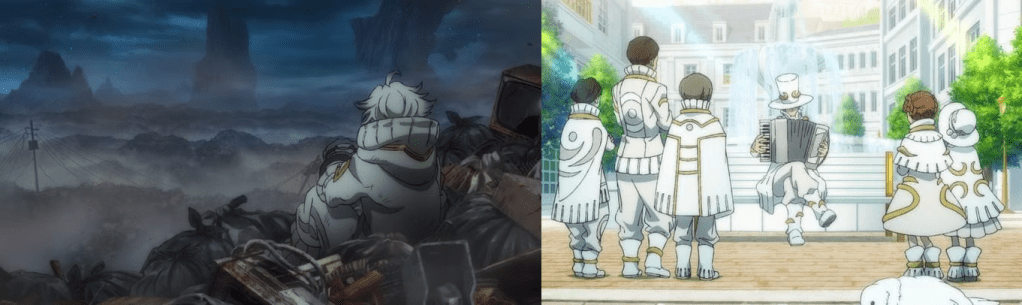
The world of Gachiakuta is split into two main places: the Sphere and the Pit. The Sphere is where the rich and powerful live. Everything is clean, bright, and almost painfully white. White clothes, white buildings, white surroundings. It’s meant to look pure, perfect, and untouchable. Meanwhile, below the Sphere is the Pit—a massive dumping ground where trash, broken objects, and even people are thrown away like they never mattered.
The fact that the Pit is physically below the Sphere isn’t subtle, and it’s not supposed to be. It’s a visual way of showing how the people above see those below them: lesser, disposable, and not worth defending. If someone is cast down into the Pit, no one speaks up. No one asks questions. No one wants to be associated with “trash,” because in this world, standing up for the discarded means risking your own place in society.
One of the smartest things Gachiakuta does is show how objects are treated the same way as people. Things that could easily be fixed are tossed aside without a second thought. Once something is labeled broken or useless, that label sticks forever. Sound familiar? The anime uses trash as a symbol, but it’s really talking about people.
The contrast in visuals makes this even stronger. The Sphere, despite being clean and rich, feels lifeless. The Pit, on the other hand, is full of color. Graffiti, bold designs, messy environments, and expressive characters. Ironically, the place built from society’s leftovers feels more alive than the world that claims to be perfect. It’s a great reminder that humanity doesn’t come from cleanliness or status—it comes from struggle, emotion, and connection.
That brings us to Rudo.
Rudo is not a soft protagonist. He’s angry, sharp, and intense, and the world gives him every reason to be. He grows up surrounded by injustice, and when he’s finally cast into the Pit, it feels less like a twist and more like society showing its true face. What makes Rudo interesting isn’t just his rage, but how honest it is. He doesn’t pretend things are okay. He doesn’t hold back to look noble.
There’s a moment where Rudo straight-up smacks Amo for messing around and putting everyone’s lives at risk. No dramatic speeches. No hesitation. And importantly, no special treatment because she’s a girl. In that moment, Gachiakuta makes something clear: survival doesn’t care about excuses. Responsibility matters more than appearances. It’s harsh, but it fits the world perfectly.
The characters in the Pit are one of the anime’s biggest strengths. Everyone feels distinct. They don’t blend together or exist just to hype up Rudo. You get the sense that they all lived full lives before the story ever started. Even small interactions make their personalities shine, and the group dynamic feels natural instead of forced.
What’s especially impressive is how Gachiakuta handles its villains called the Raiders. Characters like Jabber and Zodyl, aren’t just evil for the sake of being evil. They’re dangerous, sure, but also interesting. You can tell they’ve adapted to the same brutal world as everyone else, just in different ways. They feel like products of the system, not cartoon bad guys. Even the team called Cleaners where Rudo our protagonist joins, the leader Arkha Corvus is wrapped in mystery, making you curious whenever he appears.
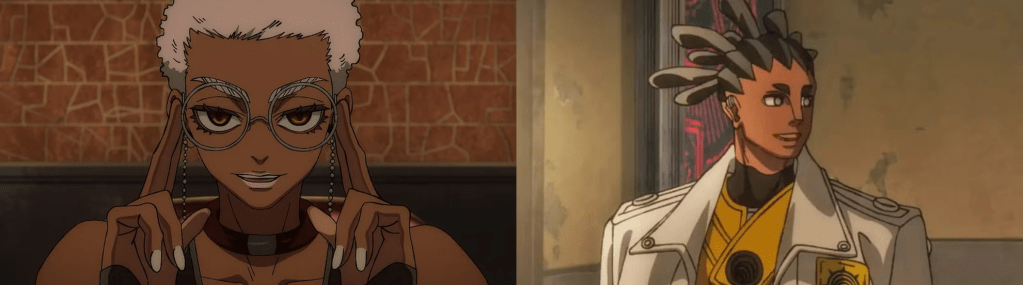
Another thing worth praising is the character design and representation. The black characters in Gachiakuta look fantastic. They’re stylish, confident, and given a strong presence without feeling forced or tokenized. They naturally belong in the world, and the anime clearly puts care into how they’re presented. It adds to the overall vibe and makes the cast feel even more diverse and real. What really ties everything together is how Gachiakuta treats morality. There’s no easy good-versus-evil line here. The people in power are cruel, but they think they’re right. The people in the Pit are fighting to survive, even if that means doing questionable things. Rudo himself walks a fine line between justice and rage, and the anime never tells you exactly how to feel about it. It trusts you to decide.
By the time you’re deep into the story, it becomes clear that Gachiakuta isn’t just about fighting with cool powers or stylish action scenes. It’s about systems, silence, and what happens when people stop accepting the roles they were assigned. It asks uncomfortable questions without shouting the answers at you.
Gachiakuta stands out because it understands that darkness isn’t just blood and violence. Sometimes it’s the quiet moment where no one steps in. Sometimes it’s the clean, white world pretending it isn’t built on discarded lives.
If you’re looking for an anime that’s intense, visually striking, full of personality, and actually has something to say, without being hard to understand, Gachiakuta is absolutely worth watching. Just be warned: once you fall into the Pit, it’s hard to look at the Sphere the same way again.
Click the image above to grab your Naruto sticker (affiliate link).
This post contains affiliate links. I may earn a commission if you purchase through them.
Bye,
Anime World Lovers.
Enjoyed this post? Support the blog.
Use whichever you’re most comfortable with.
 Anime World